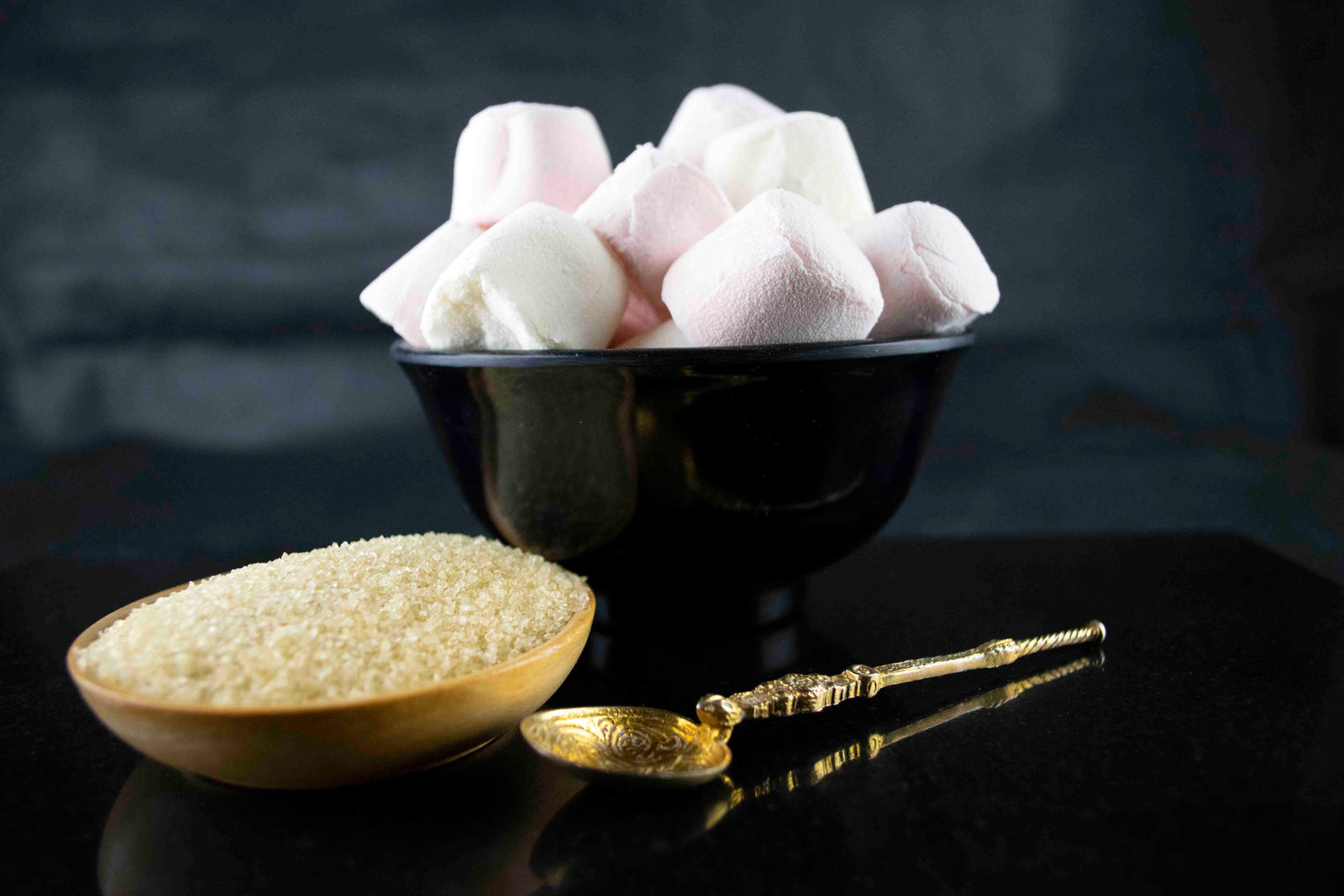
For several years, we operated Miss Marshmallow Confectionery, a successful handmade gourmet confectionery company. This is the recipe we perfected over years of production, making hundreds of batches across twenty different flavours for food festivals and online customers.
Important: This is a professional recipe designed for commercial production and will need adaptation for home use.
Understanding the Ingredients
Each ingredient plays a specific role in texture, taste, and shelf life. Understanding these relationships is essential for professional marshmallow production.
Sugar (Sucrose)
Sucrose tends to crystallise at high concentrations, which directly affects shelf life. Controlling this crystallisation is fundamental to professional marshmallow making. To prevent crystallisation, you'll need a "doctoring" agent such as glucose syrup.
Glucose Syrup
Glucose syrup is produced through the hydrolysis of edible starch. American glucose typically comes from cornstarch (corn syrup), while European versions use wheat or potato starch. The critical specification is DE (dextrose equivalent), which indicates how much the starch molecule has been broken down into simpler sugars.
For this recipe, use 42DE glucose syrup. Other options include 27DE and 63DE, each with different viscosity, reactivity, and sweetness levels. Glucose syrup is significantly less sweet than sucrose, so it both prevents crystallisation and reduces overall sweetness.
This doctoring agent acts as a humectant, preventing the marshmallows from drying out. It also enhances flavour release and creates a tender texture. While honey is technically an invert sugar, its distinct flavour makes it unsuitable for most marshmallow applications. Invert sugar is sweeter than sucrose.
Dextrose provides a pleasant, clean, sweet, cooling taste and excellent mouthfeel. On a sweetness scale where sucrose equals 100, dextrose rates 75. Unlike sucrose, dextrose doesn't undergo inversion, so its sweetness remains stable.
Dextrose and sucrose are often combined to balance sweetness and total solids, helping to create less cloying marshmallows.
This is the critical structural ingredient. We used 240 Bloom pork gelatine, though beef, fish, or chicken gelatine can be substituted. Different gelatine types may require glucose level adjustments. For detailed information on gelatine selection and use, please see our other blog posts on this topic.
Cornflour (Starch)
Quality cornflour allows you to reduce gelatine quantities in the recipe. It's also essential for dusting marshmallows during cutting to prevent sticking.
Release Agent
An oil-based spray release agent is necessary for lining the trays where you'll deposit the marshmallow mixture.
Essential Equipment
Planetary Mixer
This is a significant investment. You'll need professional-grade equipment to handle the quantities in this recipe—something like a Hobart or KitchenAid 6.9L professional mixer with whisk attachment. Do not attempt this with domestic equipment; you will burn out the motor. Start whisking at low speed and gradually increase to maximum.
Sugar Thermometer
A reliable thermometer is absolutely essential. Marshmallow making is impossible without accurate temperature control.
Trays
This recipe fills three trays measuring 12cm × 17cm × 2.5cm. Metal trays work best.
Large Pot
You'll need a very large pot (approximately 20 litres) as the sugar mixture froths up considerably during cooking.
Scales
Accurate scales capable of measuring up to 5kg are essential for consistent results.
Guitar Cutter
While marshmallows can be cut by hand, a guitar cutter is essential for regular production. We used a 22mm width cut. This is another expensive but worthwhile investment for professional production.
Miscellaneous
You'll also need jugs, spoons, bowls, and food-safe plastic containers.
Flavouring Your Marshmallows
Marshmallows can be flavoured with almost anything, but we exclusively used the finest natural flavours and colourings—no artificial ingredients.
Our range included premium vanilla paste, high-quality chocolate, and excellent coffee for classic flavours. For fruit varieties, we boiled and juiced local raspberries, blackcurrants, blackberries, and strawberries. Our citrus marshmallows featured boiled-down juice and zest from fresh limes and lemons. Quality ingredients make all the difference.
The Recipe: Madagascan Vanilla Marshmallows
Ingredients
Sugar (sucrose): 400g
Invert sugar: 400g
Dextrose: 900g
Glucose syrup: 300g
Water: 300g
Gelatine: 80g
Water (for gelatine): 400g
Cornflour (starch): 48g
Vanilla paste: 80g
Cornflour (for dusting)
Method
Safety Warning: You are working with extremely hot liquid sugar that can cause severe and painful burns. Even a single drop on skin is extremely painful. Exercise extreme caution throughout this process.
Coat trays with release emulsion.
Combine sugar, invert sugar, dextrose, glucose, starch, and 300g water in your large pot.
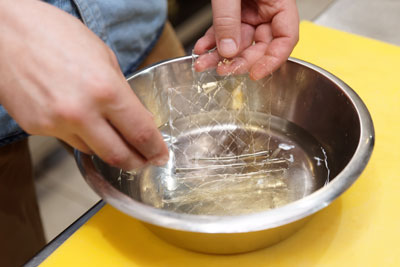
Mix gelatine powder with 400g water in a jug and set aside for at least 30 minutes to bloom (see our post on blooming gelatine for detailed instructions).
Measure vanilla paste into a bowl.
Bring the sugar mixture to the boil. Using your sugar thermometer, heat to exactly 120°C. Temperature is critical—too high or too low will result in failure. Once it reaches 120°C, remove from heat and allow to cool to 100°C.
Just before the sugar mixture reaches 100°C, heat the bloomed gelatine in a bain-marie or microwave until it becomes a very warm liquid. Do not allow it to boil.
When the sugar mixture reaches 100°C, combine it with the liquid gelatine and vanilla paste in your planetary mixer bowl. Begin whisking at low speed, quickly increasing to maximum speed. Take great care as the hot liquid will splash. The mixture should expand to fill the 6.9L bowl to the brim.
Pour into prepared trays, cover, and set aside for at least 12 hours. Do not refrigerate.
Cutting the Marshmallows
After 12 hours, turn the marshmallow slabs out into containers with a generous amount of cornflour. The mixture is extremely sticky—don't touch it until thoroughly dusted with cornflour. Once dusted, cut using a guitar cutter or knife, then dust well again with cornflour. Shake to remove excess.
When sealed in airtight bags, these gourmet marshmallows will keep for approximately 6 weeks.