
Shop Now



Beef Collagen



How to Use Gelatine for Toddler Sensory Play (Taste-Safe & Easy)
Play Activity Ideas for Younger Children using Gelatine.
Young children love to explore textures and tastes as they play, and sensory play is
really important for their development, so it is equally important that anything that they
put in their mouths is taste-safe.
Set Gelatine is an ideal medium for setting up imaginative play possibilities, as well as
allowing children to explore textures.
The set-up can be as basic as making wobbly, squishy cubes, or it can involve them in a world of imaginative play.
I prefer to use unflavoured gelatine as its bland taste makes it unappealing to eat, so it is safe to taste, but it’s much less likely that children will actively want to consume it!
To start:
1. Make up the gelatine powder according to the instructions.
Hint: You can vary the proportions of water and gelatine powder to get different levels of
‘squishiness’ in the end product. Increasing the amount of powder will give you a firmer set. Try out various options - your child can explore any that you make.
2. Optional: add a little food colouring at this stage, depending on the play experience you are planning.
HInt: Only add a little food colouring! Sometimes food coloring can stain fabric, so unless you are using protective clothing, it would be wise to avoid intense colours!
3. Allow the gelatine to set. It could be poured into a lightly oiled or lined container before setting so that it will come out cleanly.
Hint: Before the gelatine sets you might want to add other food safe items for texture, maybe some edible glitter, or small toys for imaginative play scenarios.
Here are some play ideas to get you started, but use your imagination!!
● Sensory blocks
1. Make or cut jelly cubes, or other shapes, in different sizes.
2. Toddlers love to squish them in their hands and feel the jelly squeeze out through their fingers.
3. You could add small food-safe items for texture, eg oats, scrunched up cereal, small peas.
Warning - Choking Hazard
* Chunks of gelatine can be slippery and thick - do not leave toddlers unsupervised when playing with gelatine blocks, do not allow them to put large chunks in their mouths.
* Do not add any sensory items to the blocks that could be a choking hazard.
(Helping a choking child.)
● Underwater World
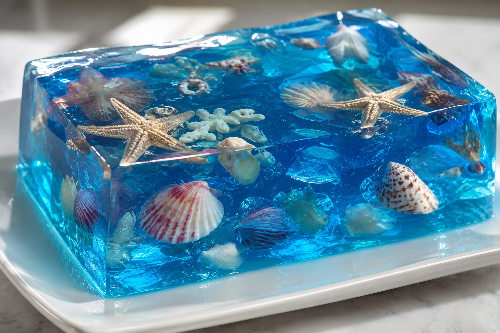
1. Dye the gelatine blue, then add small shells, sea creature models, pebbles, or even a
few items of ‘treasure’, before allowing it to set. For younger children, avoid the shells,
pebbles or small ‘treasure’ items.
2. Give children tweezers, tongs, spoons and scoops to ‘rescue’ the creatures etc from
the sea/ice.
3. Children could then wash everything in a bowl of warm water.
● Farm/Zoo Fun
1. Dye the gelatine brown and add unsweetened cocoa powder, then add plastic farm or
zoo animals, and maybe even some appropriate vehicles, before allowing it to set.
2. The children can use their hands, or spoons, to dig out the animals and vehicles. They
can make tracks in the gelatine pieces that are left, using the vehicles.
3.They can wash the animals in warm water, or, if you are outside, they could help the
animals to roll themselves clean on the grass.
● Building work
1. Colour some gelatine a brick red colour and cut into brick shapes when set. Colour
some grey/brown and leave in sheet form.
2. Children can ‘drive’ building site vehicles over the sheets to leave tracks, cut into it with
the vehicle attachments, dig and fill holes, bulldoze it, move the brick shapes in their
cranes and back hoes and build a wobbly wall!
3. The Vehicles can then be washed clean in a warm water ‘car wash’ using a nail brush.
● Paleontologist/Archeologist
1. Dye the gelatine brown and add unsweetened cocoa powder, oats, puffed rice etc to
give an ‘earthy’ texture. Add toy dinosaurs, toy dinosaur skeletons, plastic bugs, maybe
even some crystals and gems, before letting the gelatine set.
2. Children can use small tools to excavate the items.
3. Use stiff paintbrushes and warm water to clean the ‘finds’.
4. Pre-schoolers could examine them with a hand lens and be encouraged to draw them
in a ‘special notebook’. This activity works well if the items they ‘unearth’ are new to
them - ‘real’ discoveries! I often pick up little things in a charity shop that are suitable
for this sort of activity.
● Colour Magic
1. Prepare gelatine in the 3 primary colours, red, blue and green. Chop into cubes when set and put each colour in a different container.
2. Give children some empty containers and let them experiment with adding different colours of cubes together and squishing them up to get a marbled effect, eventually the mixed gel pieces will have the appearance of a different colour.
3. For pre-schoolers, challenge them to see how many different colors they can make using red, yellow and blue. Keep each colour they make in a separate container so they can count them at the end.

● Kitchen
1. Make batches of gelatine in different colours, and, when set, cut it into cubes, chunks, strings, scoops etc.
2. Let children use safe kitchen utensils to prepare and serve ‘food’ eg plastic plates and bowls, muffin tins, potato masher, ice-cream scoop, whisk, plastic cutlery, ladle, spatula
3. Allow children to sprinkle on edible glitter etc to decorate their ‘food’.(Tip: coloured desiccated coconut also makes a taste-safe topping.)
4. Provide washing up bowls, warm water, dishcloths and towels to clean everything afterwards.
Your child will probably find other ways to play with the gelatine, and will be learning through
play all the time.
Storage of the Play Gelatine
Cut blocks can be stored in an airtight container, in the fridge, for up to 7 days.
Disposal of the Play Gelatine
The set Gelatine should be disposed of in a food waste bin, and not down the sink, as there is a possibility that it could clog the drains.