
Shop Now



Beef Collagen



The Science of Blooming Gelatine: From Molecular Mechanics to Bloom Strength
Gelatine Powder Blooming: A Technical Analysis
1. Terminology note
“Blooming” is used two distinct ways in gelatine science, and conflating them causes most confusion:
• Blooming (the process) hydrating dry gelatine in cold liquid before it’s incorporated into a formulation.
• Bloom (the specification) a numeric gel strength rating (30 to 300 g Bloom) named after its inventor, Oscar T. Bloom, who patented the test in 1925.
Both derive from the same root. The test itself involves letting a solution “bloom” (swell) for 16 to 18 hours before measurement, but one is a technique, the other is a spec sheet number. This document covers both, because understanding the spec explains why the technique matters.
2. What gelatine actually is
Gelatine is denatured collagen, almost always Type I collagen from bovine hide/bone, porcine skin, or fish skin. Native collagen is a triple helix of three polypeptide chains held together by hydrogen bonds and imino-acid (proline/hydroxyproline) stacking. Acid or alkaline hydrolysis (plus heat) breaks these hydrogen bonds and cleaves some covalent crosslinks, unwinding the helix into single, disordered chains, that’s gelatine. When gelatine is later dissolved and cooled, fragments of the triple helix partially reform between adjacent chains, creating a physical (not covalent) crosslinked network that traps water. That reformed helical network is what makes a gel a gel, and it’s thermoreversible. Melt it and the helices unwind again.
Powdered gelatine is this hydrolyzed protein, dried and ground. In dry form, its chains are in a glassy, tightly coiled, hydrogen-bonded state.
3. The molecular mechanism of blooming
When you add dry gelatine powder to liquid, several things happen in sequence:
1. Surface wetting. Water contacts the hydrophilic carbonyl and amine groups on exposed chain surfaces.
2. Diffusion into the particle. Water migrates into the amorphous regions of each granule. This is diffusion-limited, not instantaneous, it’s why blooming takes minutes, not seconds.
3. Glassy-to-rubbery transition. As water content rises, the polymer’s glass transition temperature (Tg) drops below ambient temperature, and the granule softens from a rigid glass into a swollen, rubbery hydrogel particle. The granule can swell to several times its dry volume without dissolving, the chains are still too entangled/coiled to fully disperse into solution at room temperature.
4. No dissolution yet. Critically, blooming is not equal to dissolving. A bloomed granule is fully hydrated but still a discrete swollen particle. True molecular dispersion (untangling into free chains in solution) requires heat, typically 40 to 60°C, applied after blooming.
Why you can’t skip straight to heat
If dry gelatine powder is dropped directly into hot liquid (or dissolved without pre-hydration), the outer surface of each granule swells and gels almost instantly, forming a hydrated skin around a still-dry core. This skin is nearly impermeable to further water diffusion, a phenomenon sometimes called case hardening, and the interior never fully hydrates. The result is visible lumps of half-dissolved gelatine that persist even with vigorous stirring, and a final product with unpredictable, reduced gelling power because a fraction of the gelatine never actually participates in the network.
Pre blooming in cool water solves this because the granule hydrates slowly and uniformly before any gelling can lock in a barrier. Once fully swollen, the now permeable, water-saturated particle disperses cleanly and quickly when heat is applied.
4. The Bloom strength scale
|
Property |
Detail |
|
Inventor / year |
Oscar T. Bloom, patented 1925 |
|
Test solution |
6.67% w/w gelatin in water |
|
Conditioning |
Held 16–18 hours at 10°C to fully gel |
|
Measurement |
Force (in grams) for a 0.5”-diameter plunger to depress the gel surface 4 mm without rupture |
|
Typical range |
~30–300 g Bloom |
|
Rough bands |
Low: 50–125 · Medium: ~125–175 · High: 175–300+ |
Bloom strength correlates with several practical properties simultaneously:
• Firmness: higher Bloom is equal to a firmer gel at equal concentration (gel strength scales roughly with the square of concentration, so small dosage changes have outsized firmness effects).
• Melting and setting point: higher Bloom gelatine's set faster and melt at a slightly higher temperature.
• Gelling speed: higher Bloom gels set faster.
• Efficiency: higher Bloom gelatine achieves a given firmness at a lower use rate, which matters for cost and for texture (less gelatine is equal to a less “gummy” mouthfeel for the same set).
Bloom strength is not a purity or quality grade, a 120 Bloom gelatine isn’t inferior to a 250 Bloom, it’s simply specified for a softer application (yogurt, mousse) versus a firmer one (gummies, capsules).
Bloom values are approximately additive by proportion: blending equal parts 200 and 300 Bloom gelatine yields roughly 250 Bloom, which is how manufacturers fine-tune intermediate grades.
5. Practical blooming procedure (technical parameters)
|
Parameter |
Typical value |
Why |
|
Water temperature |
Cold, ~10–20°C |
Above ~40°C, surface gelling begins before full hydration; case-hardening risk rises with temperature |
|
Powder : water ratio |
~1:4 to 1:5 by weight |
Enough free water for complete granule swelling without leaving large excess to dilute later |
|
Bloom time |
5–10 min for powder; 10–15+ min for sheet gelatine (which has a thicker profile) |
Diffusion-limited hydration needs time proportional to granule/sheet thickness |
|
Dissolving temperature (after bloom) |
40–60°C |
Enough thermal energy to untangle swollen chains into true solution, without denaturing |
|
Upper limit |
Avoid sustained temps >90°C |
Prolonged high heat hydrolyzes peptide bonds further, permanently degrading gelling capacity — this is irreversible, unlike the thermoreversible melt/set cycle |
|
Acidic formulations (pH < 4) |
Increase gelatine dose ~10–15% |
Low pH partially disrupts helix reformation, weakening the set |
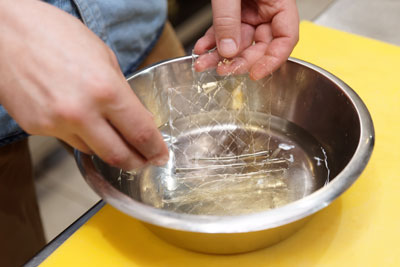
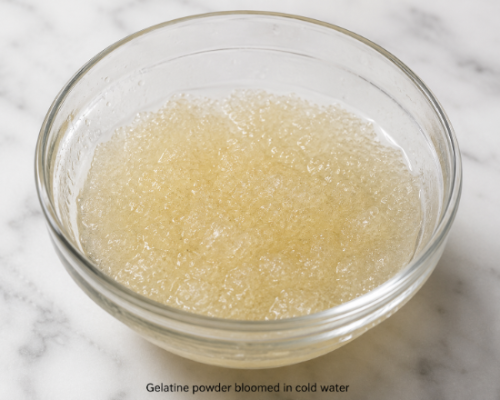
Visual/tactile end point: properly bloomed powder looks like a cohesive, slightly translucent, swollen mass with no dry, opaque, or gritty granules remaining. If liquid is still pooling separately and granules feel gritty, hydration is incomplete.
6. Variables that change bloom behavior
• Particle size / mesh: finer powder hydrates faster (more surface area) but is also more prone to clumping if added too quickly, since many granules can surface-gel and stick together simultaneously.
• Source: fish gelatine has a lower average Bloom and melts near body temperature (useful for mouthfeel, problematic for shelf stability in warm climates); bovine and porcine gelatine's run higher Bloom and melt higher.
• Concentration in the final formulation: because strength scales with concentration², errors in dosing are amplified nonlinearly in final firmness.
• Sugar, salt, and acid content: high sugar concentrations can slow hydration; salts and acids can compete for water or disrupt helix formation, both usually requiring dose adjustment.
7. Broader applications beyond food
The same blooming logic, controlled hydration before use, governs gelatine’s behavior in every field that uses it, though the why it matters shifts:
|
Field |
Application |
Bloom strength typically used |
What blooming controls here |
|
Confectionery |
Gummies, marshmallows, pâte de fruit |
200–250 |
Chew texture, set speed, shelf stability |
|
Culinary (savory/sweet) |
Panna cotta, aspic, mousse, clarification (consommé) |
125–200 |
Softness/mouthfeel, clarity of the final gel |
|
Pharmaceuticals |
Hard and soft capsule shells |
~150–225 (grade-specific) |
Shell integrity, dissolution rate in the GI tract, moisture content at encapsulation |
|
Pharmaceuticals |
Microencapsulation / controlled drug release |
Formulation specific |
Coating uniformity and release kinetics depend on complete, lump-free hydration |
|
Photography |
Silver-halide emulsion binder |
High purity, tightly specified Bloom |
Uniform dispersion of light-sensitive crystals; incomplete hydration causes emulsion defects |
|
Cosmetics |
Face masks, capsule-based serums, gel creams |
Varies by texture target |
Spreadability and set firmness |
|
Biomedical |
Hemostatic sponges (e.g., gelatin foam), wound dressings, tissue-engineering scaffolds |
Medical grade, tightly controlled |
Pore structure and mechanical strength depend on uniform, defect-free gelation |
|
Ballistics testing |
10% ordnance gelatin blocks simulating tissue density |
~250–300 |
Reproducible density/consistency for standardized penetration testing |
|
Industrial |
Paper sizing, matchhead binder, fining agent in winemaking/brewing |
Lower purity technical grades |
Even coating/binding without lumps or streaks |
The common thread: any application where gelatine needs to form a uniform, defect free network, whether that network’s job is “chewy candy” or “controlled drug release” or “reproducible ballistic density” depends on complete, even hydration at the blooming stage. A partially hydrated batch produces the same category of defect everywhere: inconsistent set, embedded lumps, or unpredictable mechanical/release properties, just with different consequences depending on the field.
8. Common failure modes and diagnosis
|
Symptom |
Likely cause |
Fix |
|
Gritty lumps that won’t dissolve even after heating |
Powder added to hot/warm liquid; case hardening |
Always bloom in cold liquid first; never add powder directly to hot liquid |
|
Weak or no set despite correct proportions |
Overheating during dissolution (>90°C sustained), or high acidity |
Lower dissolving temperature; increase dose for acidic formulations |
|
Cloudy or grainy final gel (where clarity is needed, e.g. aspic) |
Incomplete hydration before heating, or boiling introduced air/degradation |
Confirm full bloom (no dry granules) before gentle warming; avoid boiling |
|
Inconsistent firmness batch-to-batch |
Bloom-strength variation between gelatine lots, or inconsistent water ratio |
Source consistent Bloom-graded gelatine; standardize hydration ratio and time |
Sources consulted
• Gel Strength / Bloom testing technical references (gelstrength.com, packqc.com)
• Cape Crystal Brands, gelatin Bloom conversion and hydration guidance