A Beginner's Guide to Leaf Gelatine: Just to emphasise it - this is a beginner’s guide to leaf gelatine, aimed at the home cook who wants to make some interesting desserts, or maybe sweets.
There are main stages involved in preparing leaf gelatine for use in sweets or desserts.
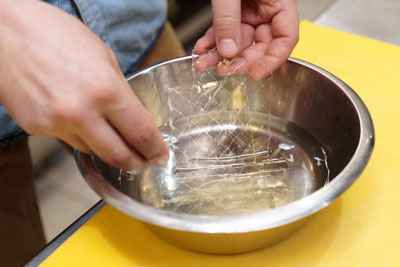
1. Bloom the sheets in cold water
2. Squeeze out the excess water
3. Dissolve the soggy sheets in a warm liquid
4. Allow to set
That sounds very easy, but there are some hints and tips that you really need to be aware of before you get started, so let’s go through it step-by-step:
1. Blooming the ‘leaves’ of Gelatine
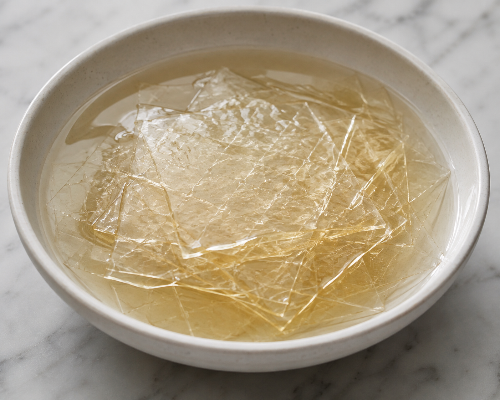
● All gelatine leaves need to be soaked before use.
● The water needs to be very cold, icy cold, so you could start off with water to which you've added ice cubes. Do NOT use warm water, that sounds counter-intuitive, but if you do the leaves will melt and be ruined.
● Place the leaves in one-by-one, they do not need to be broken up unless your container is too small, and then you might need to snap them in half.
● If you are blooming multiple layers of leaves, make sure that you put them in the water so that a layer of water separates each leaf.
● The amount of water that you need to use is often not given in a recipe. For beginners it is best to simply make sure that there is sufficient water to completely cover the leaves*.
● Soak the leaves until they are soft and floppy, they will look a bit wrinkly. This usually takes 5-10 minutes
● Be aware that you can over-bloom gelatine sheets - over-bloomed sheets will look torn or mushy, they are fragile and will fall apart when you pick them up and try to squeeze them. If this happens it might be better to start again, as you can’t be sure how much usable gelatine you would be adding to your dish.
● If the leaves are not soaked enough, you might end up with small lumps in your jelly and it might not set properly, so don’t be tempted to hurry this process.
2. Removing the excess water from the Gelatine
● Simply scoop the leaves out of the liquid and allow the water to drain off them through your fingers.
● Gently squeeze the sheets with your fingers - you are not aiming to make them into a lump, just to get more water out of them. (If you leave too much water in them, then, depending on your recipe, your jelly might be less firm or have diluted taste.)
● You discard the liquid you soaked the leaves in - it is not added to the dish.
3. Dissolving the Gelatine in warm liquid
● Melt the soft leaves of gelatine by adding them to the liquid you are using in your recipe and warming gently.
● You can carefully swish the liquid in the pan or use a spoon to stir it gently.
● The liquid can be milk, cream, or water based. Some fruit juices will work well, but some fresh raw fruits like kiwi, papaya and pineapple, contain enzymes which will stop the gelatine from setting. It is usually possible to use tinned (canned) versions of these fruits, because the heating process they go through destroys those enzymes.
● Do NOT boil the liquid - high temperature destroys the gelatine’s setting power.
4. Setting the Gelatine
● Now the liquid can be poured into a mould or container to set.
● At this stage inclusions can be added, although some people prefer the jelly to be set slightly so that inclusions can remain suspended - this part is trial and error!
● You can also make and set jelly in layers and add inclusions on top of a layer or use different jelly colours; make sure you only add cold liquid to a set jelly layer.
● Gelatine does not need to be refrigerated to set; the setting is essentially a chemical reaction, but chilling the liquid will speed up the process and usually gives a firmer ‘set’.
● Setting can also be speeded up by melting the gelatine initially in a relatively small quantity of liquid and then adding that to a larger quantity of cold liquid.
● Setting will not happen if the temperature is warm (under 20°C (68°F) is best).
● As a setting shortcut, you can try putting the mixture in a freezer for 15 mins to cool it down, before putting it in the fridge to set.
Sometimes a jelly just doesn’t set - and it might be possible to ‘rescue’ it by blooming an extra sheet of gelatine, rewarming the liquid and melting the extra sheet into it.
* As a beginner and a home cook, you're unlikely to be making products in volume for release etc., however, if you decide to move on you might wonder how you can ensure product consistency, which is very important in business.
You will need to make sure that both the amount of water absorbed by the sheets when you bloom them, and the amount of water that you rinse off, is the same each time,
with respect to the number of sheets, you are using. Variations in this can cause differences in the texture, mouthfeel and ‘wobble’ of the final product.