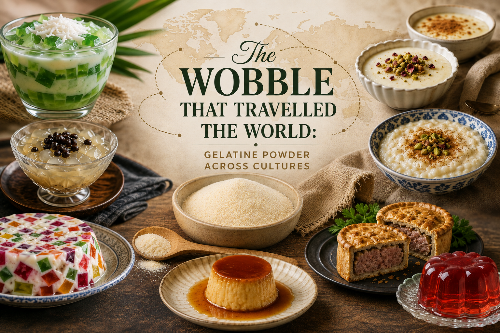
The Wobble That Travelled the World: Cultural Uses of Gelatine Powder
Gelatine powder seems like a humble kitchen staple, a flavourless, odourless protein derived from collagen, usually sourced from the skin, bones, and connective tissue of pigs, cows, or fish. But trace it across the globe and you'll find it doing wildly different jobs, from setting delicate desserts to thickening savoury broths to holding together snacks eaten on street corners. Here's a tour of how different food cultures have made gelatine their own.
Britain and Ireland: The Jelly Tradition
In the UK, gelatine's most iconic role is in "jelly" (what Americans call Jell-O). Molded fruit jellies have been a fixture of British party tables and children's birthdays for over a century, often set in elaborate copper or ceramic moulds shaped like rabbits, castles, or fish. Beyond dessert, gelatine underpins pork pies , the clear jelly that fills the gap between the meat and the pastry crust as the pie cools is made by boiling down pork bones and setting the resulting stock, sometimes with a boost from powdered gelatine for consistency. Aspic, a savoury jelly used to encase meats, eggs, or vegetables, was a mainstay of Victorian and Edwardian dinner tables and is seeing a small revival among nose-to-tail and retro-cooking enthusiasts.
France: Precision and Pâtisserie
French cuisine treats gelatine with the precision of a chemist. In pâtisserie, gelatine sheets or powder are essential for bavarois (a light, moulded cream dessert), mousses, and the glossy mirror glaze (glaçage miroir) that coats modern entremet cakes. Savoury French cooking uses it in terrines and pâté en croûte, where a gelatine-rich stock is poured around cooked meat to bind and preserve it once chilled. Classic French technique also relies on natural gelatine released from long-simmered veal or chicken bones to give sauces their glossy, "nappant" (coating) texture, a reminder that before powdered gelatine existed, cooks extracted it the slow way.
Middle East and the Levant: Milk Puddings and Sweets
In Turkey, the Levant, and parts of the Gulf, gelatine (or its plant-based cousin, mastic-thickened puddings) plays a starring role in muhallebi and sütlaç-style milk puddings, giving them a silky, sliceable set. Turkish lokum (Turkish delight) traditionally uses starch rather than gelatine, but many modern commercial and homemade versions now use gelatine for a softer, glossier bite. Gelatine-set fruit puddings flavoured with rosewater, orange blossom, or pistachio are common at celebrations and during Ramadan iftar spreads.
South Asia: A Contested Ingredient
In India, Pakistan, and Bangladesh, gelatine occupies an interesting cultural position because a large proportion of the population avoids it for religious or dietary reasons, most commercial gelatine is derived from pork or non-halal/non-kosher beef sources, and vegetarians avoid animal-derived gelatine outright. Where it is used, it appears in milk-based mithai like some varieties of badam katli substitutes, gelatine-set fruit custards, and in bakery products like glazed fruit tarts. This has driven strong regional demand for agar-agar (derived from seaweed) as a plant-based, halal and vegetarian friendly substitute, agar sets firmer and holds up better in warm climates, which is part of why it became the dominant choice in many South and Southeast Asian kitchens.
East Asia: Beyond Dessert
● Japan: Gelatine appears in wagashi-adjacent modern sweets and in nikogori, a savoury jelly made from fish broth that naturally sets due to the high collagen content of fish bones and skin, powdered gelatine is sometimes added to guarantee a firm set. Agar-agar (kanten) remains more traditional for classic Japanese sweets like anmitsu and mizu yokan.
● China: Gelatine-based sweets are less common than agar or tapioca based ones, but donkey-hide gelatine (ejiao) is a completely different tradition — a thick, dark gelatine block made from donkey hide, used not primarily as a food-texturiser but as a traditional Chinese medicine tonic, often dissolved into warm water, wine, or congee and believed to nourish blood and skin.
● Korea: Gelatine appears in modern confectionery, but traditional Korean jellies more often use mukuk (starch based jellies like dotorimuk, acorn jelly), showing again how starch and seaweed gels often predate and coexist with animal gelatine in Asian food traditions.
The Americas: From Jell-O Culture to Latin Desserts
The United States turned powdered gelatine into a 20th-century cultural phenomenon with Jell-O, marketed aggressively from the early 1900s and central to mid-century "congealed salad" culture, savoury-sweet moulded dishes combining gelatine with mayonnaise, canned fruit, vegetables, or even seafood, a style now viewed with a mix of nostalgia and amusement. In Latin America, gelatine desserts are far more elaborate and celebratory. Mexican gelatinas de mosaico ("mosaic jellies") layer brightly coloured cubes of set gelatine suspended in a creamy gelatine base, often sold by street vendors and made for birthdays. Flan, popular throughout Latin America, sometimes uses gelatine alongside or instead of a baked egg custard for a firmer, more portable set, especially in home cooking.
Central and Eastern Europe: The Savoury Stronghold
In Poland, Hungary, Russia, and neighbouring countries, gelatine's savoury role dominates. Galareta (Poland), kholodets (Russia and Ukraine), and disznósajt (Hungary) are all variations on jellied meat, pork trotters, hocks, or mixed meats simmered for hours to release natural collagen, then set into a firm, sliceable terrine, traditionally served cold with vinegar or mustard at festive winter meals. These dishes predate powdered gelatine by centuries, but modern home cooks often add a spoonful of powdered gelatine to guarantee a firm set regardless of how much natural collagen the meat yields.
Southeast Asia: Layered and Colourful
In the Philippines, Indonesia, and Malaysia, gelatine and agar are used almost interchangeably in vibrant layered desserts. Filipino buko pandan and multicoloured gulaman drinks and desserts showcase gelatine or agar cut into cubes and mixed with coconut milk or sweet syrups. Malaysian and Indonesian gelatine puddings and agar-agar santan (coconut agar jelly) are common at gatherings, often set in decorative layers using both gelatine and agar for different textures within the same dish.
Why the Same Ingredient, So Many Uses?
Gelatine's versatility comes down to simple food science: it's a protein that dissolves in warm liquid and reforms into a solid, elastic gel as it cools, with no flavour of its own to compete with the dish. That blank canvas quality let very different culinary traditions bend it toward their own priorities, whether that's the show stopping mould of a Mexican birthday jelly, the silky bite of a Turkish milk pudding, or the deep umami hold of a Polish jellied meat. It's also why regions with religious dietary restrictions or strong vegetarian traditions developed parallel plant-based gelling agents like agar-agar and pectin, which now sit alongside gelatine as equally important,if very different,tools in the cook's kit.
Next time you use gelatine powder, you're tapping into a technique that connects a Victorian pork pie, a Mexican mosaic jelly, and a bowl of Russian kholodets, all held together, quite literally, by the same simple protein.